
The 101st Airborne Division: Revolutionizing Warfare
How the "Screaming Eagles" Transformed Military Strategy During and After World War II
National History Day Project | 2026
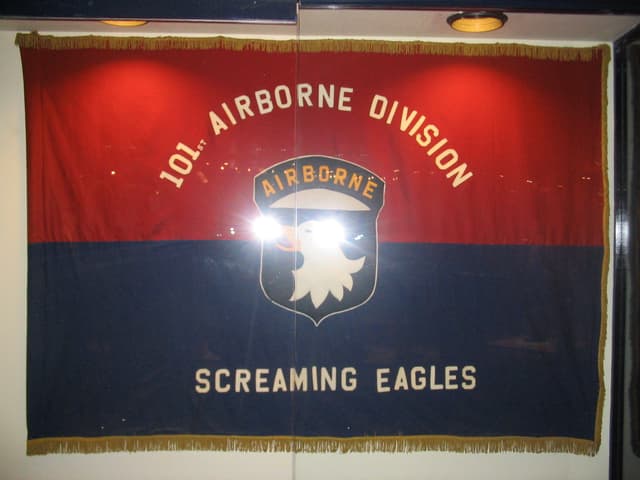
The iconic 'Screaming Eagle' flag of the 101st Airborne Division. (Belgian Museum)
Introduction: A New Kind of Soldier
When the United States entered World War II, military strategists faced a fundamental challenge: how could they project force behind enemy lines quickly enough to disrupt defensive positions and create opportunities for advancing ground troops? The answer came in the form of a revolutionary new military concept—the airborne division. Among these elite units, none would prove more influential or legendary than the 101st Airborne Division, the "Screaming Eagles."
Activated on August 16, 1942, at Camp Claiborne, Louisiana, the 101st Airborne Division would go on to fundamentally change how modern militaries think about warfare. Their innovations in vertical envelopment, combined arms operations, and rapid deployment tactics continue to influence military doctrine around the world more than 80 years later.
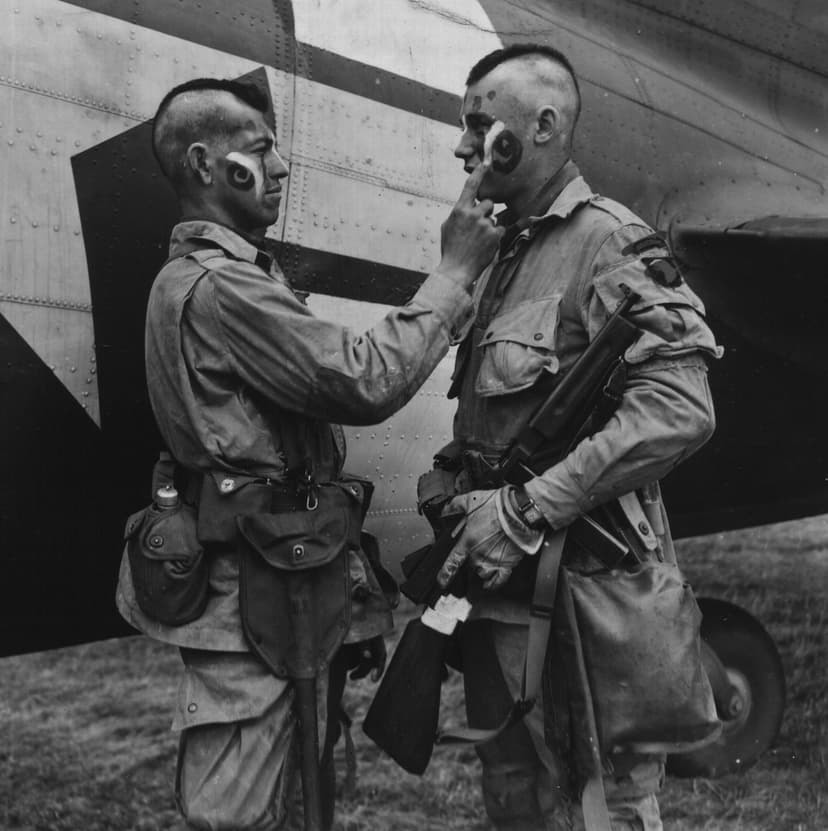
Pvt. Clarence Ware applies war paint to Pvt. Charles Plaudo before D-Day, June 1944. (U.S. Army Signal Corps)
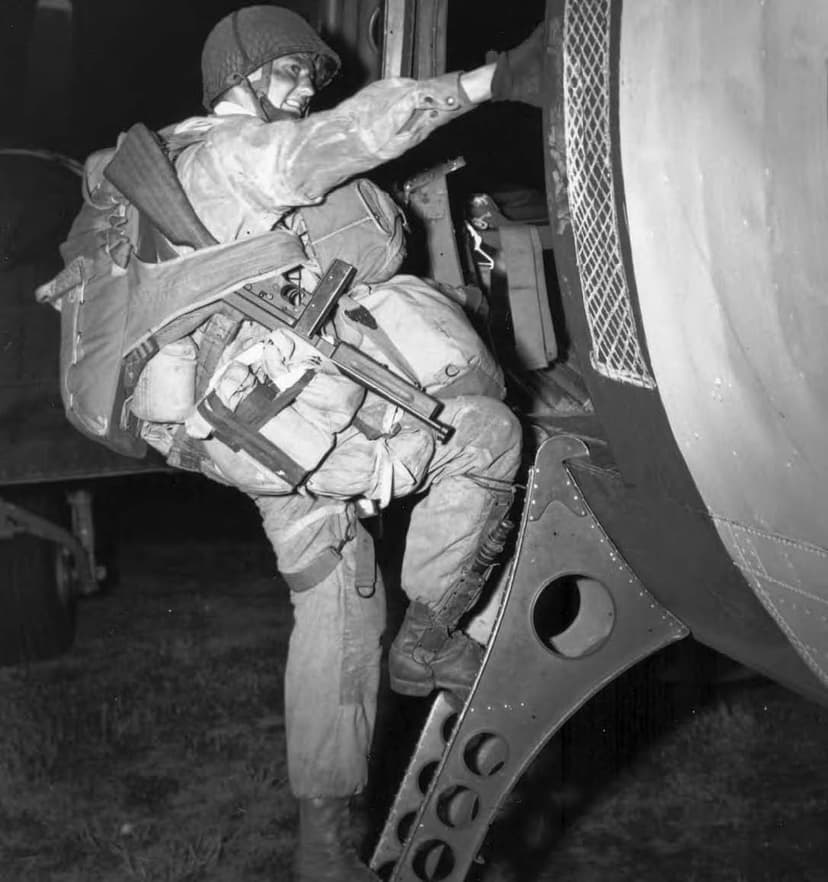
Sgt. Joseph Gorenc of the 101st boards a C-47 'Stoy Hora' on the night of June 5, 1944. (U.S. Army)
The Birth of Airborne Warfare
The concept of inserting troops from the air was not entirely new—the Soviet Union and Germany had experimented with paratroopers in the 1930s. However, it was the American military that would perfect the integration of airborne forces into a comprehensive operational strategy. The 101st Airborne was designed from the ground up to be a self-sufficient fighting force capable of operating independently behind enemy lines for extended periods.
Training for the division was extraordinarily rigorous. Volunteers underwent five weeks of intensive jump school at Fort Benning, Georgia, where they learned not just how to parachute from aircraft, but how to fight immediately upon landing. Unlike traditional infantry, airborne soldiers had to be proficient in a wider range of weapons and tactics because they could not rely on the heavy equipment and support that accompanied regular ground forces.
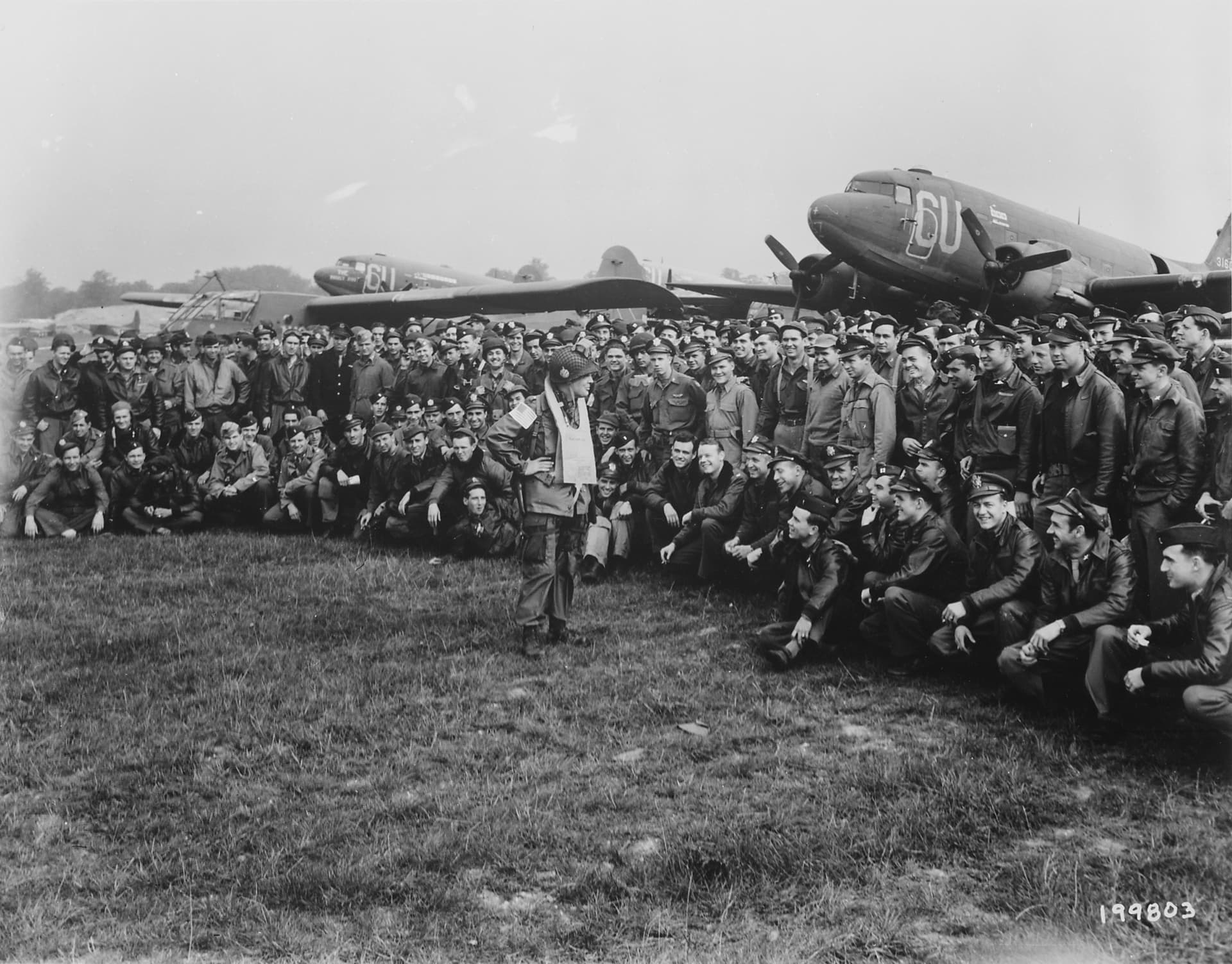
Brig. Gen. Anthony McAuliffe gives final instructions to glider pilots, June 5, 1944. (U.S. Army)
D-Day: The Ultimate Test
The 101st Airborne's first major combat operation would also be one of the most important military operations in history: the Normandy invasion on June 6, 1944. In the early morning hours before the beach landings, over 6,600 men of the 101st parachuted into the darkness over the Cotentin Peninsula. Their mission was to secure the exits from Utah Beach, destroy bridges and causeways that could be used for German counterattacks, and create chaos behind enemy lines.
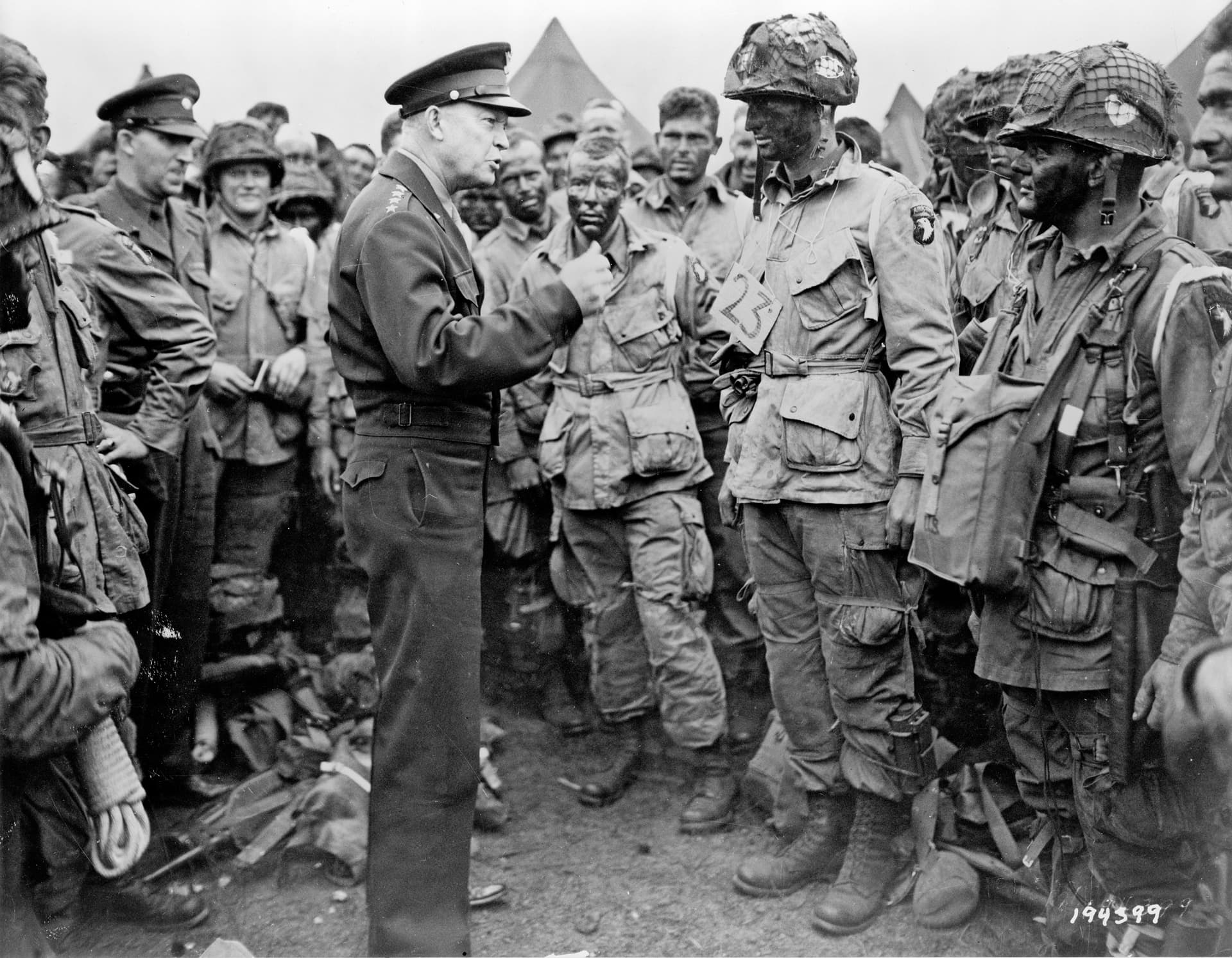
Gen. Eisenhower gives the order of the day — 'Full victory, nothing less' — to paratroopers, June 5, 1944. (U.S. Army)
The drop was far from perfect. High winds, anti-aircraft fire, and pilot error scattered the paratroopers across a wide area, with some landing miles from their intended drop zones. Many soldiers drowned in flooded fields that the Germans had deliberately created. Yet this apparent disaster revealed one of the most revolutionary aspects of airborne operations: the chaos worked both ways.
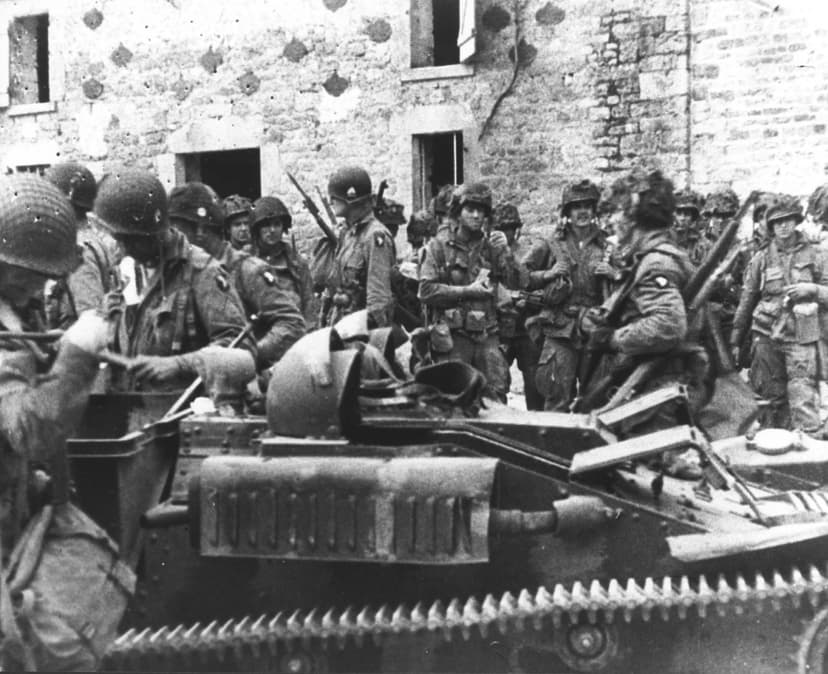
Paratroopers regroup at 'Marmion Farm' near Ravenoville, France, June 6, 1944. (U.S. Army)
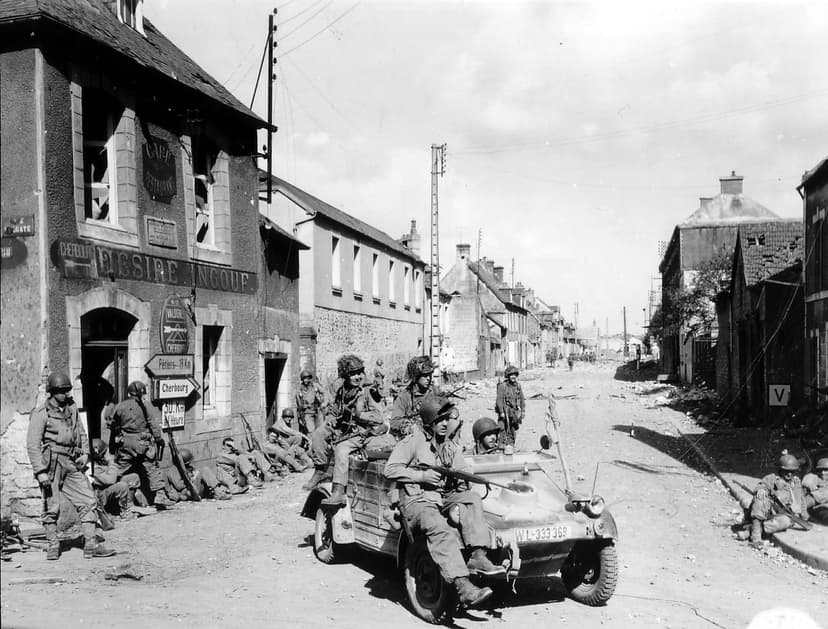
American paratroopers drive a captured German vehicle through Carentan, June 1944. (National Archives)
German defenders found themselves under attack from seemingly every direction. Small groups of paratroopers, unable to find their units, formed ad-hoc teams and attacked targets of opportunity. This demonstrated a principle that would become central to modern special operations: highly trained, motivated soldiers operating in small units could achieve effects far greater than their numbers would suggest.
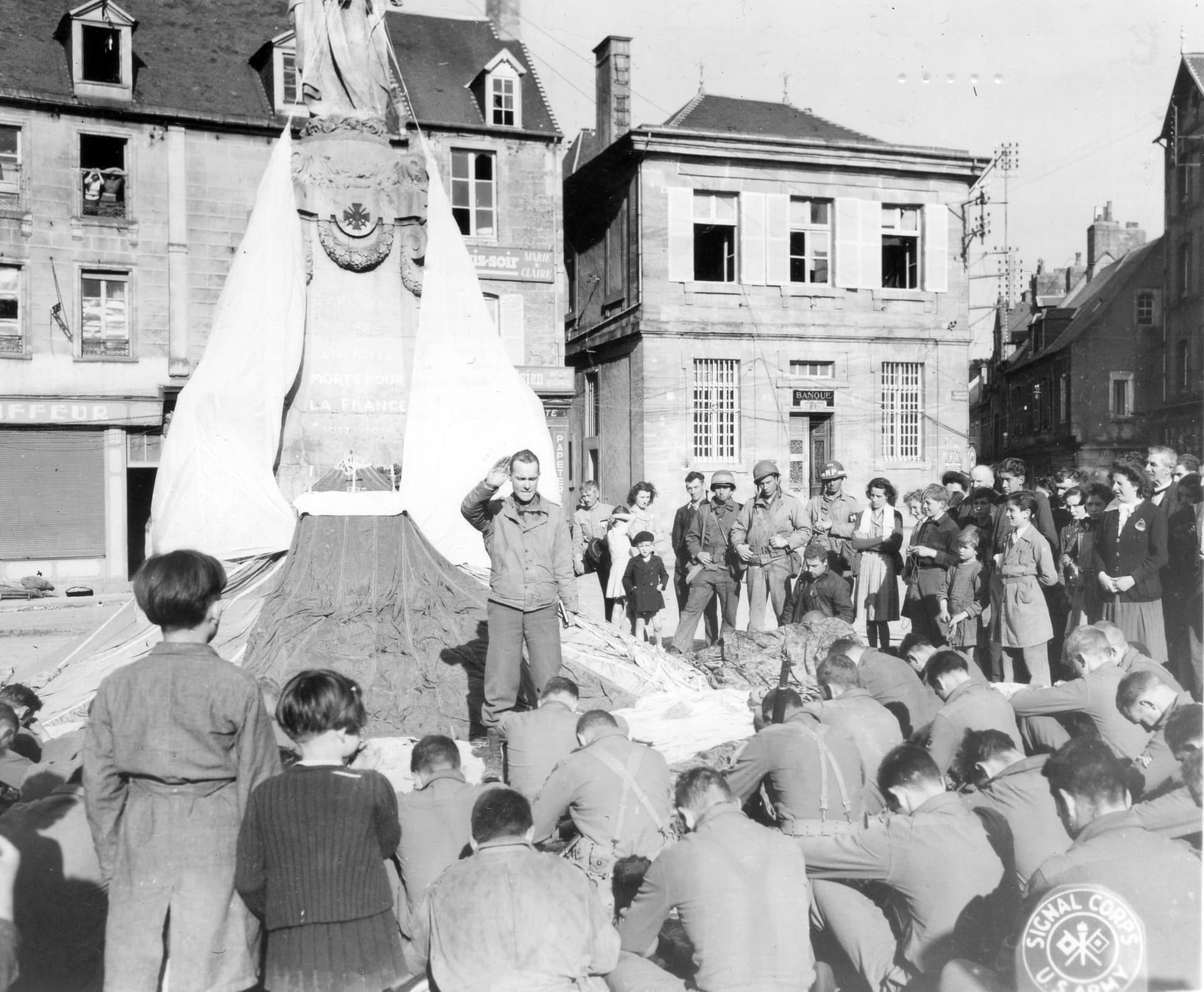
Chaplain holds a prayer service for the fallen in the square of Carentan, June 19, 1944. (Signal Corps)
Operation Market Garden: Lessons in Ambition
In September 1944, the 101st participated in Operation Market Garden, the largest airborne operation in history. The plan called for airborne forces to seize a series of bridges in the Netherlands, creating a corridor for ground forces to advance into Germany. The 101st successfully captured its objectives around Eindhoven and Veghel, demonstrating the division's growing expertise in airborne operations.
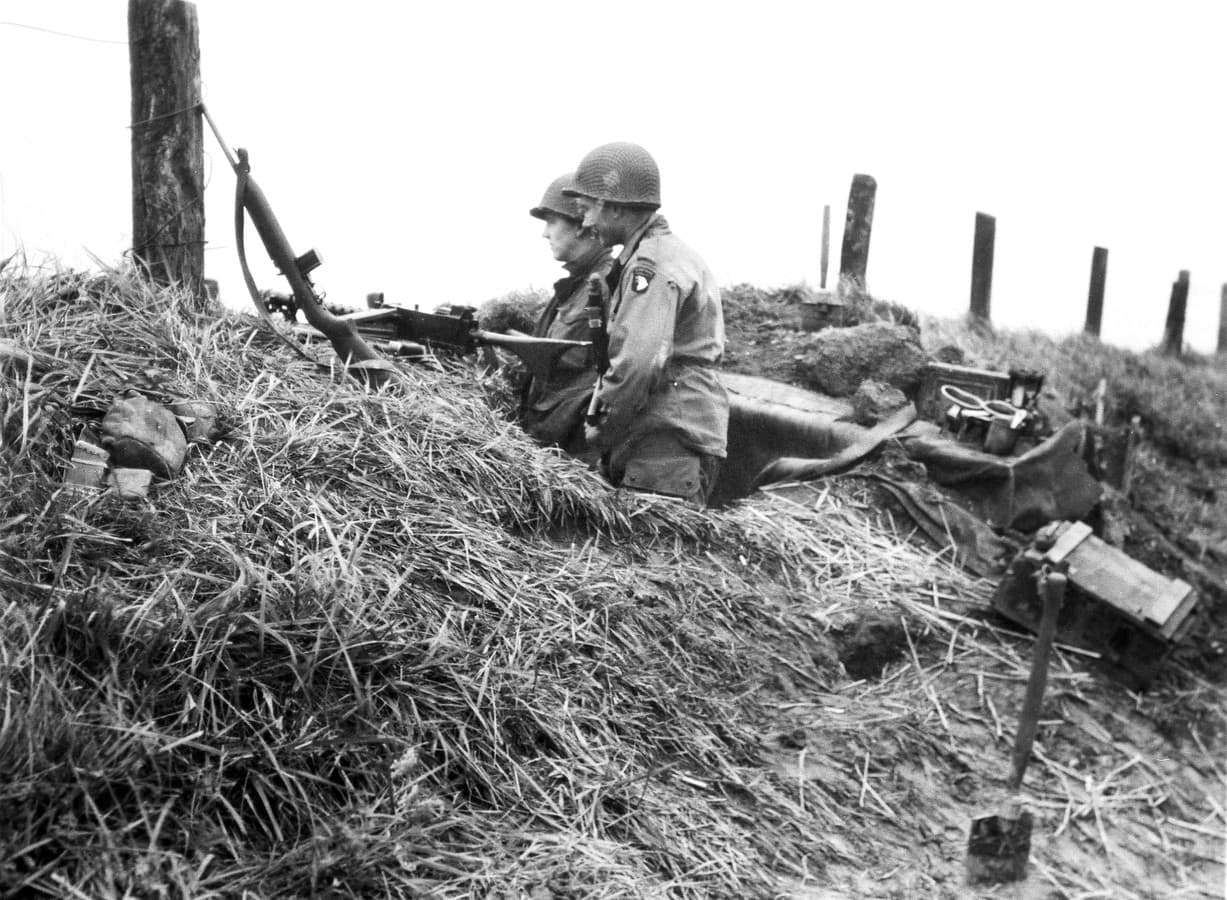
Paratroopers of the 506th PIR in a foxhole near Randwijk, Holland, October 1944. (U.S. Army)
While the overall operation failed to achieve its ultimate goal of crossing the Rhine, the 101st's performance provided valuable lessons about the capabilities and limitations of airborne forces. These lessons would inform military planning for generations, emphasizing the importance of realistic objectives, secure supply lines, and the dangers of underestimating enemy capabilities.
Bastogne: "NUTS!" and the Spirit of Airborne
The 101st Airborne's most famous stand came during the Battle of the Bulge in December 1944. When German forces launched a surprise offensive through the Ardennes forest, the 101st was rushed to the strategic crossroads town of Bastogne, Belgium. Arriving by truck rather than parachute, the division found itself completely surrounded by German forces within days.
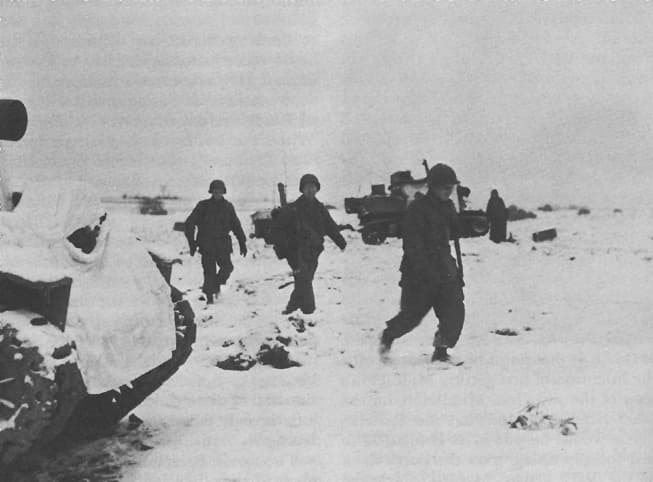
101st Airborne paratroopers moving up to Bastogne, December 1944. (U.S. Army)
Cut off from resupply, running low on ammunition, food, and medical supplies, and facing overwhelming enemy numbers, the situation seemed hopeless. When German commanders sent a message demanding surrender, Acting Division Commander Brigadier General Anthony McAuliffe gave his famous one-word reply: "NUTS!"
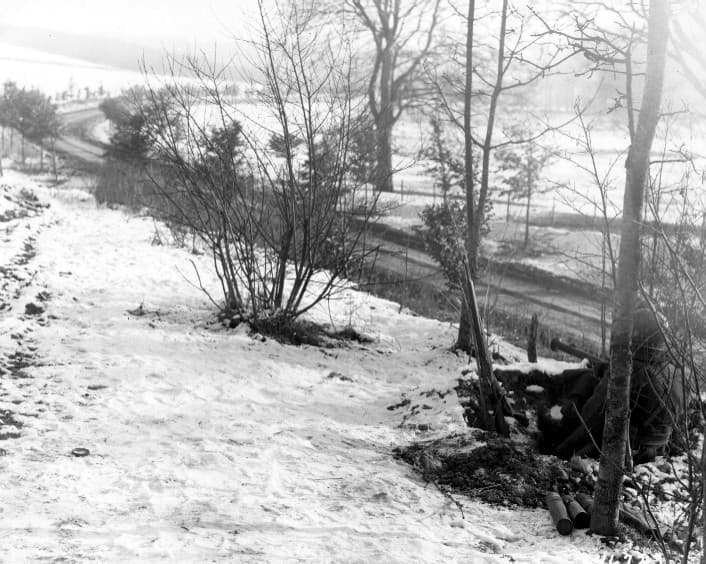
101st soldiers armed with bazookas guard against German tanks near Bastogne, Dec 23, 1944. (U.S. Army)
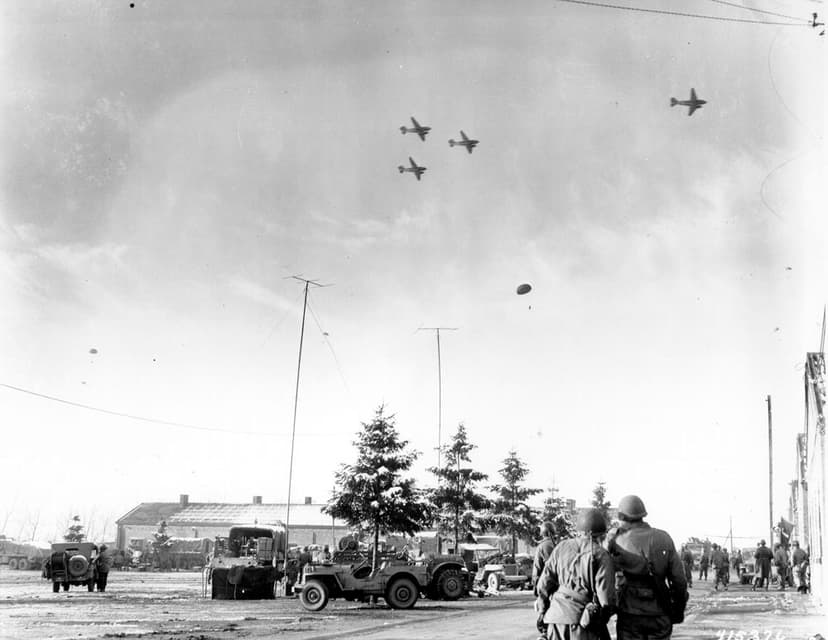
101st Airborne soldiers watch C-47s drop critical supplies during the Siege of Bastogne. (U.S. Army)
For over a week, the 101st held Bastogne against repeated German assaults, buying time for General Patton's Third Army to break through and relieve them on December 26. The defense of Bastogne demonstrated that airborne forces, trained to operate behind enemy lines with minimal support, possessed the resilience and fighting spirit to hold against far superior numbers. This capability to act as a strategic "fire brigade," rapidly deploying to critical points, would become a defining characteristic of airborne forces.
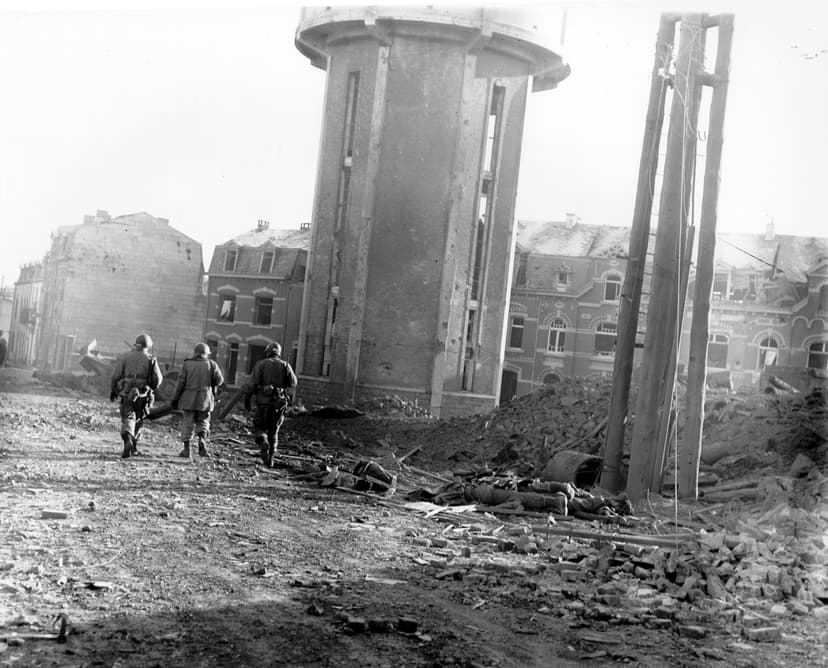
Members of the 101st walk past fallen comrades killed in the Christmas Eve bombing, Dec 25, 1944. (U.S. Army)
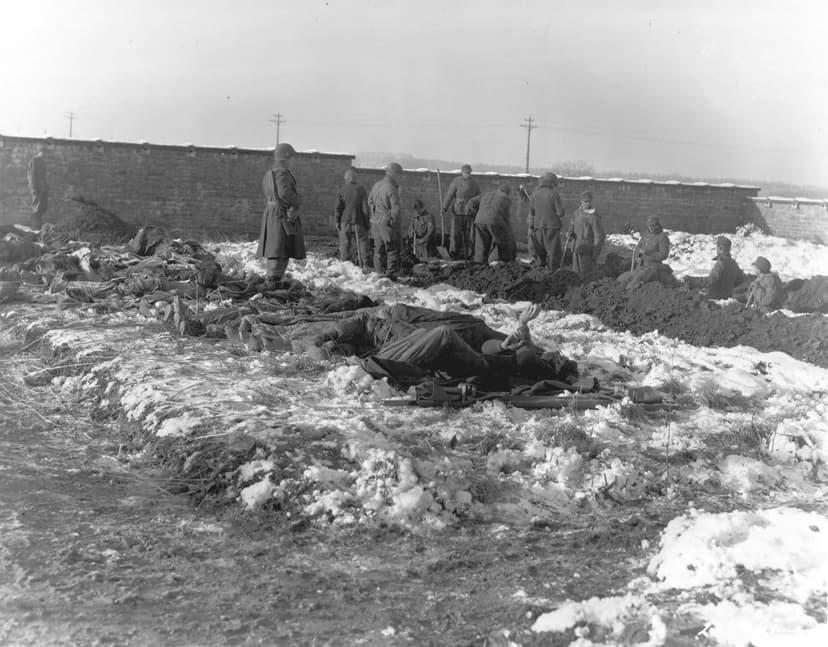
German POWs dig graves for 101st Airborne soldiers killed defending Bastogne. (Signal Corps)
Victory in Europe and the Eagle's Nest
The 101st Airborne continued fighting through the final months of the war, participating in the invasion of Germany and eventually capturing Hitler's mountain retreat at Berchtesgaden—the Eagle's Nest. This symbolic victory was a fitting end to the division's European campaign.
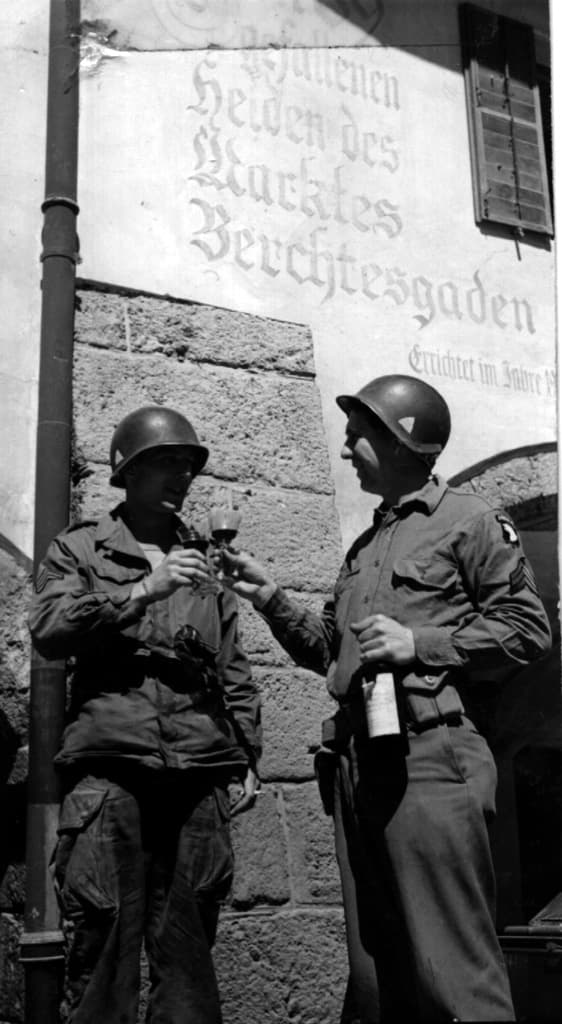
101st Airborne soldiers toast victory with wine from Hitler's private cellar at Berchtesgaden, 1945. (U.S. Army)
Legacy and Continuing Impact
The 101st Airborne's influence on warfare extended far beyond World War II. In 1968, the division was reorganized as an airmobile division, pioneering the use of helicopters for rapid troop deployment. This transformation, tested in the jungles of Vietnam, created an entirely new form of warfare: air assault.
Today, the 101st Airborne Division (Air Assault) continues to serve as one of the U.S. Army's premier rapid deployment forces. The division has seen action in Operation Desert Storm, Operations Enduring Freedom and Iraqi Freedom, and continues to stand ready to deploy anywhere in the world on short notice.
The tactical innovations pioneered by the 101st Airborne have become standard military doctrine. Vertical envelopment—attacking the enemy from above and behind—is now a fundamental concept in military planning. The idea that small, highly trained units can achieve strategic effects has evolved into modern special operations forces. The helicopter assault tactics developed by the division are used by militaries worldwide.
Conclusion
The 101st Airborne Division did more than win battles—it fundamentally changed how modern warfare is conducted. From the chaotic night drops over Normandy to the frozen forests around Bastogne, from the helicopter assaults in Vietnam to the rapid deployments of the 21st century, the Screaming Eagles have consistently demonstrated that innovation, courage, and adaptability can overcome seemingly impossible odds.
The division's motto, "Rendezvous with Destiny," has proven prophetic. The 101st Airborne's destiny was not just to fight in World War II, but to revolutionize warfare itself—a legacy that continues to shape military operations around the world today.
Sources and Further Reading
- Ambrose, Stephen E. Band of Brothers. Simon & Schuster, 1992.
- Rapport, Leonard and Arthur Northwood Jr. Rendezvous with Destiny: A History of the 101st Airborne Division. 101st Airborne Division Association, 1948.
- Koskimaki, George. D-Day with the Screaming Eagles. Casemate Publishers, 2011.
- Marshall, S.L.A. Bastogne: The First Eight Days. Center of Military History, 1946.
- National Archives and Records Administration. World War II Photograph Collection.
- U.S. Army Center of Military History. "101st Airborne Division."
Image Credits
All photographs used in this project are official U.S. Army photographs from World War II, now in the public domain. Sources include:
- U.S. Army Signal Corps photographs via Wikimedia Commons
- U.S. National Archives and Records Administration (NARA)
- U.S. Army Center of Military History
- Library of Congress Prints and Photographs Division
As works of the U.S. federal government, these photographs are in the public domain and may be used freely for educational purposes.